| Safety and regulation
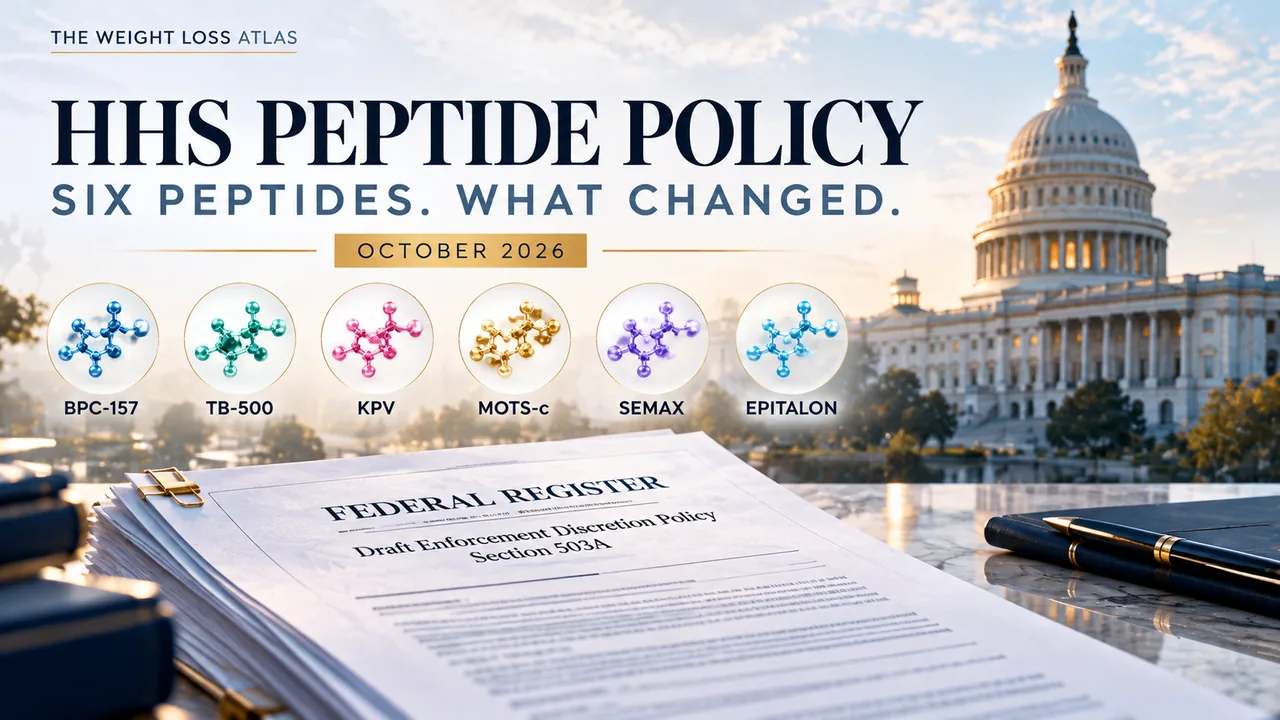
On October 30, 2026, the Federal Register published a notice from the U.S. Department of Health and Human Services (HHS) about a new policy for compounding peptides. HHS made the 16-page policy document public two days earlier. It names six peptides: BPC-157, Epitalon, KPV, MOTS-c, Semax and TB-500.
The short version: HHS says it does not plan to take enforcement action against licensed compounders that meet a list of conditions. That is not an FDA approval, and it does not put these peptides on the official 503A bulks list. It approves no weight-loss treatment, and it does not make MOTS-c an FDA-approved obesity medicine.
What HHS announced
The document is titled "Enforcement Discretion Policy Regarding 503A Compounding Using Certain Peptide Bulk Drug Substances." Enforcement discretion means an agency says it does not intend to act against conduct that might otherwise break a rule, as long as stated conditions are met. HHS says the policy applies until each peptide is addressed in a final rule on the bulks list.
The Federal Register notice calls the document a draft. It says the document creates no rights and does not bind HHS or the public. Written comments are accepted until two weeks after publication, about November 13, 2026. HHS may revisit the policy if a safety signal or product quality problem appears.
This follows the October 14 report that a draft had gone to the White House budget office. That item is now history, and we kept it, with an update, in our earlier report. The peptide policy tracker has the full timeline.
The six peptides and the routes HHS names
Appendix B gives each peptide's chemical form and the routes HHS considers within the policy. A route is how a medicine enters the body. The table repeats what the document says. It is not a recommendation.
| Peptide | Chemical form named | Routes named by HHS |
|---|---|---|
| BPC-157 | Acetate | Subcutaneous, intramuscular, oral and topical |
| TB-500 | Acetate | Subcutaneous or intramuscular injection |
| Epitalon | Acetate | Subcutaneous or intramuscular injection, dispensed in intermittent courses |
| Semax | Free base | Intranasal |
| KPV | Acetate | Topical and oral |
| MOTS-c | Acetate | Subcutaneous or intramuscular injection |
Source: Appendix B of the HHS policy document. Emideltide (DSIP), which FDA's committee did not recommend in July, is not on the list.
Why the route matters
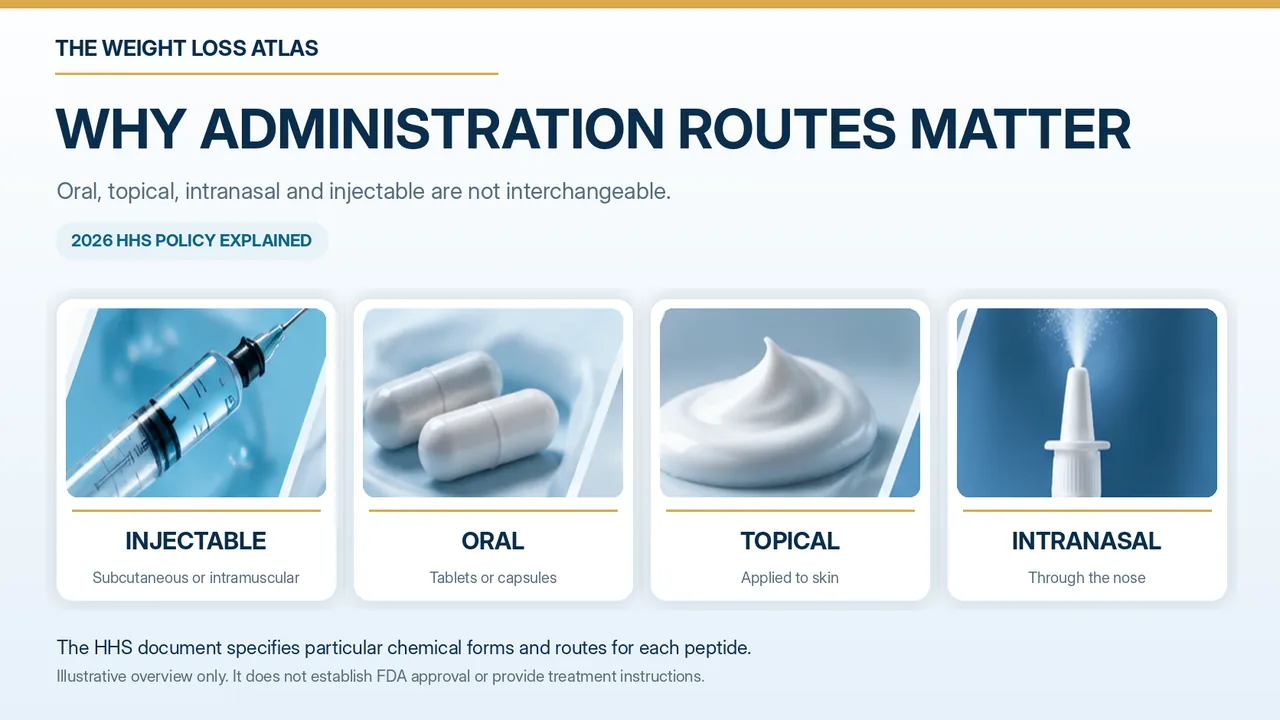
Oral, topical, nasal and injected forms are not interchangeable. Many peptides are broken down in the gut, and HHS says injection should be the standard route because of low oral bioavailability, meaning little of a swallowed dose may reach the bloodstream. A compounder offering an oral form is expected to document that the exact formulation achieves adequate levels in humans. The only device allowed in the package is an FDA-cleared syringe.
Who can compound, and under what conditions
The policy covers state-licensed pharmacies, federal facilities and licensed physicians. HHS holds off on enforcement only when every condition is met. In plain terms:
- A prescription for an identified patient, and compliance with other federal rules, including no insanitary conditions.
- One of the six peptides, matching the identity in Appendix B and staying within the routes listed there.
- An ingredient from an FDA-registered manufacturer with a valid certificate of analysis (COA) that names the facility. A repacker or reseller must have checked both.
- Only one active ingredient from the list in each product.
- A label that says "This is a compounded drug product. Not for resale."
- Reports of serious adverse events and product quality problems to FDA's MedWatch program and to the states.
Why a purity number is not enough
A COA is a lab report on one lot of ingredient. HHS says it should show testing for identity, purity and potency, and for contaminants such as endotoxins, heavy metals and microbes. A purity percentage alone does not show that the right molecule is in the vial, what the impurities are or where it was made.

Why this is not FDA approval
Approval means FDA reviewed evidence that a medicine is safe and effective for a stated use and reviewed how it is made. HHS's own document says FDA does not review compounded drugs for safety, effectiveness or quality before they are marketed. The safeguards here are conditions placed on compounders, such as sourcing, testing records and adverse-event reporting. They are not a government review of any finished product.
Even a place on the bulks list would only mean a pharmacy may use the ingredient. These peptides have not reached that step. In July an FDA committee recommended six of the seven peptides it reviewed, although FDA staff had recommended against adding them, and that vote is advice only. Most published research on these peptides is in animals or the laboratory.
Licensed pharmacies are not online research-chemical sellers
The policy is for licensed compounders filling prescriptions. It does not cover websites that sell peptides labeled "for research use only" or "not for human consumption." FDA says products sold that way have been marketed for human use, and it advises against buying them. Such a product is not a pharmacy-compounded drug made under these conditions. HHS says one aim of the policy is to discourage use of research-use-only peptides from foreign manufacturers, which it says pose a safety risk. That is HHS's reasoning, not a finding that compounded versions are safe.
What this means if you follow GLP-1 medicines
None of the six is a GLP-1 medicine, and the policy does not name semaglutide, tirzepatide, retatrutide or any other weight-loss drug. Nothing in it changes the approval status of any of them.
Compounded semaglutide and tirzepatide remain covered by FDA's separate position that they are not approved and not reviewed for safety, effectiveness or quality. Retatrutide is not approved, and FDA says it cannot be used in compounding under federal law. See compounded versus brand-name medicines and what FDA safety reports show.
FDA's July agenda listed obesity among the uses evaluated for MOTS-c. Being named in this policy does not make it an obesity medicine. HHS's reasons for including it cite lot testing, documented use, and safety findings from a trial of a MOTS-c analogue and from rodent studies. Rodent results do not show weight loss in people.
What changes for patients
This report gives no doses and does not recommend any product, pharmacy or telehealth service. Questions to ask a prescriber are on the peptide policy tracker.
- What changes: HHS has said how it plans to treat licensed compounders of these six peptides, and it has set conditions.
- What does not change: none is FDA-approved, none is on the bulks list, and the evidence in people is limited for most of them.
- What varies: state law and state boards of pharmacy are not bound by a federal enforcement policy. A prescriber decides whether any product is appropriate for you.
- What can change again: the policy is not binding, and HHS can revise it.
What comes next
- Comments close about November 13, 2026, and HHS may revise the policy afterward.
- HHS says FDA's future rulemakings may propose adding some or all of the six to the bulks list. No proposed rule has been issued.
- An FDA committee meeting on GHK-Cu, LL-37, Dihexa, Melanotan II and PEG-MGF is expected before the end of February 2027. No date is set.
- Trade groups have argued FDA cannot authorize compounding through an interim policy while rulemaking is pending, according to a law-firm review, so legal challenges are possible.
- How state boards of pharmacy respond is not yet known.
Worth knowing: HHS's policy is a statement about enforcement, not an approval. It approves no peptide and no weight-loss treatment, it puts nothing on the 503A bulks list, and it can be changed. What it changes is how HHS says it will treat licensed compounders that meet its conditions. It does not tell us whether these peptides work.
Related: Peptide policy tracker | What a 503A pharmacy is | Compounded versus brand-name medicines | Compounded GLP-1s: what FDA safety reports show | Earlier report: draft sent for review
Source: U.S. Department of Health and Human Services, policy document made public October 28, 2026 Regulator. Federal Register, 91 FR 68526, October 30, 2026. HHS notice 2026-22192, docket HHS-OASH-2026-0496 Regulator. U.S. Food and Drug Administration meeting page. Page content current as of August 6, 2026 Regulator. U.S. Food and Drug Administration. Page content current as of October 1, 2026. Adverse event counts are as of May 31, 2026 Regulator. Holland & Knight law-firm alert, October 16, 2026. Secondary source Trade press, secondary source. McDermott Will & Schulte law-firm client alert, July 27, 2026. Secondary source Trade press, secondary source.