Why promising weight-loss drugs don't always reach the pharmacy
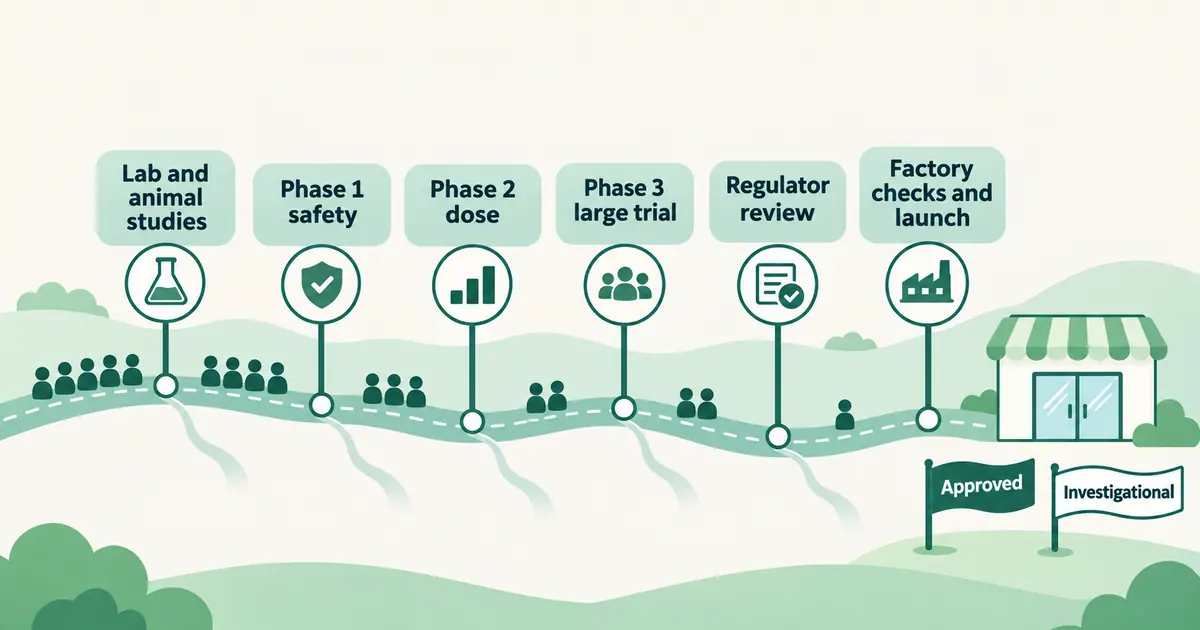
Quick answer. A weight-loss medicine can look strong in a trial and still be years from a pharmacy shelf, or never get there. Trials come in stages, each built to answer a different question. After the last trial, a regulator reviews the evidence and the factory, and the company has to make enough product to supply it. Until a regulator approves it, a medicine is investigational: it can be studied, but it is not approved for sale.
Approved, under review or investigational: where medicines stand
Each line below comes from a company statement, an FDA announcement or a trial registry, checked on Nov 12, 2026. Status can change at any time, so the date matters.
| Medicine | Where it stands | What that means |
|---|---|---|
| Semaglutide (Wegovy, Ozempic) | Approved in the U.S. | Wegovy and Ozempic both contain semaglutide but are separate products with separate approved uses. See Ozempic vs Wegovy. |
| Tirzepatide (Zepbound, Mounjaro) | Approved in the U.S. | Zepbound and Mounjaro are likewise separate products with separate labels. |
| Orforglipron (Foundayo) | Approved in the U.S. on April 1, 2026 | FDA decided 50 days after the application was filed, under a pilot program for priority review. Eli Lilly said the pill became available on April 9, 2026. |
| CagriSema | Under FDA review | Novo Nordisk says it submitted its U.S. application on Dec 18, 2025. No FDA decision had been announced as of Nov 12, 2026. |
| Retatrutide | Investigational | Eli Lilly says it plans to submit retatrutide in Q1 2027 for U.S. approval (company statement, July 23, 2026). The Atlas has found no announced filing. |
| Mazdutide | Approved in China (company-reported, June 2025); investigational in the U.S. | Each regulator decides on its own evidence and timeline. |
| UBT251 | Investigational | Phase 2 results appeared in Cell Metabolism (news page), and phase 3 trials are registered. The Atlas has found no approval in any country. |
| Danuglipron | Development ended | Pfizer ended the program on April 14, 2025 after a trial participant had a possible drug-induced liver injury that resolved once the medicine was stopped. |
Status checked Nov 12, 2026. Approval attaches to a product and a use, so a medicine can be approved for one purpose and not another. The tracker and each medicine page carry the dated detail.
The road in six stages
Each stage asks a different question, and a medicine only moves on if the answer is good enough.
| Stage | The question it answers | Who is studied | What can go wrong |
|---|---|---|---|
| Lab and animal work | Is it worth testing in people? | No people yet | Safety or activity does not hold up |
| Phase 1 | Is it safe, and how does the body handle it? | 20 to 100 healthy volunteers or people with the condition | Side effects, or the body clears it too fast or too slowly |
| Phase 2 | What dose range works, and are there early signs of benefit? | Up to several hundred people with the condition | A weak effect, or side effects at doses that work |
| Phase 3 | Does it work and stay safe in a large group? | 300 to 3,000 volunteers with the condition (TRIUMPH-1 enrolled 2,339) | Results fall short of what a regulator needs, or a safety signal appears |
| Regulatory review | Do the benefits outweigh the risks for the stated use? | The regulator reads the full evidence package | More data are requested, or the decision is not to approve |
| Manufacturing and launch | Can it be made to standard and supplied at scale? | Sites and processes are inspected | Inspection findings, or supply that lags demand |
Participant numbers in the table are FDA's general figures. FDA's own explainer also puts rough odds on each step for drugs of every kind, not obesity drugs in particular: about 70% move on from phase 1, about 33% from phase 2 and about 25 to 30% from phase 3. The page was last reviewed in 2018 and gives the phase 1 range two ways (20 to 100 in its table, 20 to 80 in its text), so treat the odds as a general picture and not a forecast for any one medicine. The pipeline page shows how many weight-management trials sit at each phase today.
Why a good result can still stop a medicine
A medicine can show a clear benefit and still leave a program, or the pharmacy, for reasons that sit outside the headline number.
- A safety signal can end a program. Pfizer stopped its oral medicine danuglipron in April 2025 after one trial participant had a possible drug-induced liver injury that resolved once the medicine was stopped. The pipeline page still lists its finished trials.
- Side effects can narrow the case. In TRIUMPH-1, 11.3% of people on retatrutide 12 mg stopped treatment because of side effects, against 4.9% on placebo, and 12.5% reported dysesthesia, an unpleasant change in skin sensation, against 0.9%. Eli Lilly reported those figures, and a regulator weighs them against the benefit. A trade-off in a trial result is not a prediction of a decision.
- The evidence can leave gaps. When issues remain, FDA says the developer may have to answer questions or run more studies before a decision.
Why one trial's percentage can't be lined up against another's
Weight-loss figures are averages. Each average depends on who was studied, for how long, at which dose, and how the analysis treats people who stopped treatment or started something else. That last choice is called the . Eli Lilly's three phase 3 obesity trials of retatrutide 12 mg show how far one dose can move.
| Trial | People studied | Weeks | Analysis approach reported | Average weight lost, 12 mg | Average weight lost, placebo |
|---|---|---|---|---|---|
| TRIUMPH-1 | Adults with obesity or overweight and a related condition, without diabetes | 80 | Efficacy estimand (results while on treatment) | 28.3% | 2.2% |
| TRIUMPH-1 | Same trial | 80 | Treatment-regimen estimand (everyone as randomized) | 25.0% | 3.9% |
| TRIUMPH-2 | Adults with obesity or overweight and type 2 diabetes | 80 | Efficacy estimand | 20.8% | 4.0% |
| TRIUMPH-3 | Adults with severe obesity and established cardiovascular disease, with or without type 2 diabetes | 80 | Efficacy estimand | 22.6% | 3.2% |
Source: Eli Lilly and Company press releases of May 21 and July 23, 2026 (company-reported). The July release gives only the efficacy-estimand figures for TRIUMPH-2 and TRIUMPH-3, so those rows cannot be matched to the treatment-regimen row from the releases alone.
Read the table this way: the same drug, dose and length gave averages from 20.8% to 28.3%, depending on who was enrolled and how the result was counted. Setting the 25.0% beside the 14.9% semaglutide produced in STEP 1 (68 weeks, everyone counted as randomized) would still not show which medicine is stronger, because the trials ran for different lengths, at different times, under different protocols and in different groups of people. Only a head-to-head trial, which randomizes people to both medicines under one protocol, is built to compare two. The trial results page lists the trials the Atlas follows, with each one's analysis approach.
Before trusting a headline figure, check who was enrolled, how many weeks the trial ran, which dose the number belongs to, which analysis approach it uses, what the placebo group lost, how many people stopped treatment, and whether it comes from a company release, a peer-reviewed paper or a conference slide. The beginner guide covers how to read trial results.
After the last trial: filing and review
A company files an application, and FDA first decides whether it is complete. If it is, FDA's general explainer says the review team has 6 to 10 months to decide whether to approve. Faster routes exist. FDA said its April 1, 2026 decision on Foundayo came 50 days after filing and 294 days before the application's target date of Jan 20, 2027, under a pilot program that aims for decisions within two months.
- A decision can be to approve or not to approve. When it is not, the developer may have to answer questions or run more studies, and can appeal.
- Approval covers a specific product, use and group of people. Wegovy and Ozempic both contain semaglutide, yet each has its own label.
- Each regulator decides separately. Mazdutide is approved in China, according to its developer, and is investigational in the U.S. The mazdutide page has the detail.
The factory is part of the application
FDA says inspections of manufacturing sites may take place before approval. They check current good manufacturing practice (CGMP), whether the site can deliver what the application promised, and whether the data are sound. An inspection result called official action indicated means the site is not in an acceptable state of compliance, and FDA says it may result in non-approval of pending applications.
Building capacity is a separate job, and it can continue after approval. Eli Lilly says a new site in Houston, where it broke ground on Sept 21, 2026, will make the active ingredient for Foundayo, among other medicines. The release gives no date for the start of production.
Approved is not the same as on the shelf
Approval does not set insurance coverage, supply or what a person pays. Those depend on plans, pharmacies and the maker. Eli Lilly said Foundayo became available on April 9, 2026, eight days after approval. The paying for GLP-1 medicines, Medicare and GLP-1 medicines and compounded versus brand-name medicines pages cover coverage and what compounded copies are.
How to check a medicine's status yourself
- Drugs@FDA lists approved products and their labels.
- DailyMed shows the current labeling for a product.
- ClinicalTrials.gov shows each registered trial, its phase and whether it is recruiting, active or finished.
- A company's own pipeline or press page shows what it says about timing. Treat that as the company's statement, not a regulator's.
- The Atlas tracker and pipeline pages gather registry dates and company statements in one place, each with the date checked. The Lilly drug codes guide explains the code names that investigational medicines carry.
Quick answers
- What does investigational mean?
- The medicine is being studied and is not approved for sale for that use. Trials, regulatory review and manufacturing checks can all still lie ahead.
- Does a positive phase 3 result mean a medicine will be approved?
- No. Phase 3 results are the main evidence a company files with a regulator. The regulator then reviews that evidence along with safety data and the manufacturing sites, and can decide not to approve.
- How long does FDA take to decide after a company files?
- FDA's general explainer says the review team has 6 to 10 months once an application is complete. A pilot program that aims for two-month decisions produced the Foundayo approval 50 days after filing.
- Why is a medicine approved in one country and not another?
- Each regulator reviews the evidence on its own and can decide at a different time. Mazdutide is approved in China, according to its developer, and is investigational in the U.S.
- Why can't I compare two trials' weight-loss figures?
- Different people, trial lengths, doses and analysis methods produce different averages. In Eli Lilly's three phase 3 obesity trials, retatrutide 12 mg averaged between 20.8% and 28.3% weight loss depending on who was studied and how the result was counted.
- Where can I see whether a trial is still running?
- ClinicalTrials.gov lists each registered trial with its phase and status. The Atlas tracker and pipeline pages follow the medicines it covers, with the date checked.
- What happens when a program stops?
- The company can end it, and the registry may keep listing the finished trials. Pfizer's danuglipron is an example on the pipeline page.
What is still unknown
- Whether FDA will approve CagriSema, and when. No decision or target date had been announced as of Nov 12, 2026.
- Whether Eli Lilly files retatrutide in Q1 2027, as it says it plans to, and what FDA decides after that.
- How retatrutide's TRIUMPH-2 and TRIUMPH-3 results look under the treatment-regimen approach. Lilly's July release gives only the efficacy-estimand figures.
- How many obesity medicines now in early trials will reach phase 3. FDA's odds cover drugs of every kind, not obesity drugs.
- The dates on this page come from company releases and FDA pages. Statuses move, so check the date beside each line.
Which approved medicine fits a person is a question for a prescriber. The questions to ask your prescriber page lists what to bring to a visit.
Sources
- Eli Lilly press release on TRIUMPH-1 results Eli Lilly and Company. May 21, 2026. Company release
- Eli Lilly press release on TRIUMPH-2 and TRIUMPH-3 results and the plan to submit retatrutide in Q1 2027 Eli Lilly and Company. July 23, 2026. Company release
- FDA approves first new molecular entity under National Priority Voucher program U.S. Food and Drug Administration. April 1, 2026. Regulator
- Eli Lilly press release on Foundayo availability Eli Lilly and Company. April 9, 2026. Company release
- Step 3: Clinical Research U.S. Food and Drug Administration, The Drug Development Process. Page content current as of Jan 4, 2018. Regulator
- Step 4: FDA Drug Review U.S. Food and Drug Administration, The Drug Development Process. Regulator
- Overview of Drug Manufacturing Inspections U.S. Food and Drug Administration. Sept 6, 2023. Regulator
- Eli Lilly press release on the groundbreaking of its Houston manufacturing site Eli Lilly and Company. Groundbreaking Sept 21, 2026. Company release
- Novo Nordisk press release on the CagriSema FDA submission Novo Nordisk. Dec 18, 2025. Company release
- Pfizer ends development of weight-loss pill danuglipron CTV News, reporting a Pfizer statement of April 14, 2025. News report of a company statement, secondary source
- Once-weekly semaglutide in adults with overweight or obesity (STEP 1) Wilding JPH, et al. N Engl J Med. 2021;384(11):989-1002. PMID 33567185. Journal article