
| Trial results
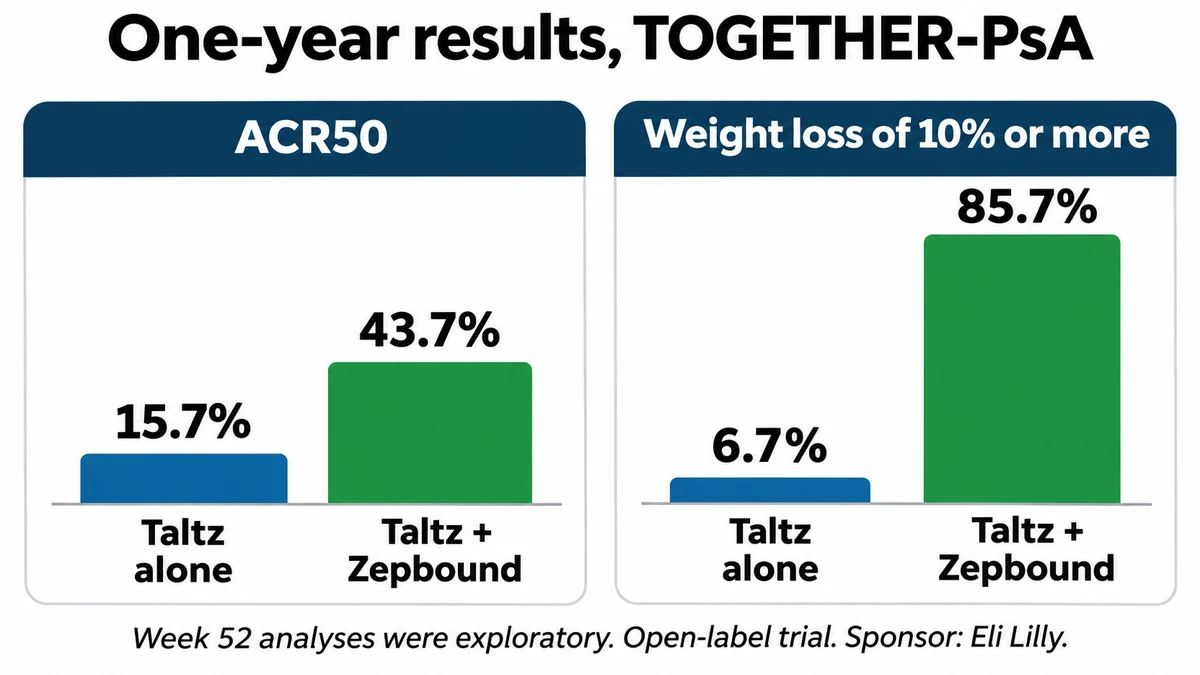
In a trial of 271 adults with psoriatic arthritis and obesity or overweight, more people reached an ACR50 response at one year, a 50% improvement in joint symptoms, when tirzepatide (Zepbound) was added to ixekizumab (Taltz): 43.7% on the combination versus 15.7% on ixekizumab alone. Weight loss was larger too. Among people on the combination, 85.7% lost at least 10% of their body weight, against 6.7% on ixekizumab alone. This is one trial. Lilly sponsored it, it was open label, and the one-year analyses are exploratory.
What the trial tested
TOGETHER-PsA (NCT06588296) randomized 271 adults, according to Lilly. All had active psoriatic arthritis and either obesity or overweight with at least one weight-related health condition. The average body mass index at the start was 37.6.
One group received ixekizumab alone. The other received ixekizumab plus tirzepatide. Both are injections under the skin, and both groups got counseling on a reduced-calorie diet and more physical activity.
The trial ran 52 weeks. Its main goal, measured at week 36, was the share of people who reached an ACR50 response and also lost at least 10% of their body weight. Lilly reported that earlier: 31.7% on the combination and 0.8% on ixekizumab alone. The numbers below are from week 52.
Results at one year
| Measure at week 52 | Ixekizumab alone | Ixekizumab plus tirzepatide |
|---|---|---|
| Reached ACR50 (a 50% improvement in joint symptoms) | 15.7% | 43.7% |
| Lost at least 10% of body weight | 6.7% | 85.7% |
| Both of those at the same time | 1.7% | 39.2% |
| Minimal disease activity (a low-activity state) | 13.6% | 28.2% |
Share of people in each group. Company-reported, from Lilly's release of November 11, 2026.
The gap in ACR50 was 28.0 percentage points, with a 95% confidence interval of 17.1 to 38.9, according to Rheumatology Live's report of the conference abstract. That is a fairly wide range, as expected with about 270 people.
What ACR50 means
ACR50 is a standard checklist from the American College of Rheumatology. To reach it, a person needs at least a 50% improvement in both tender joint count and swollen joint count, plus at least a 50% improvement in three of five other measures: pain, the person's own rating of disease activity, the doctor's rating, daily function, and a blood marker of inflammation. It is a stricter bar than ACR20, the 20% version.
What the numbers do not show
The one-year results are exploratory. Lilly says, and the paper's abstract agrees, that the week 52 analyses were planned in advance but not adjusted for testing many outcomes, so they cannot be read as proof. The trial's main goal was measured at week 36.
The trial was open label. People and their doctors knew who was taking tirzepatide. Lilly describes the trial as assessor-blinded, meaning the staff who judged outcomes did not know. Even so, several parts of ACR50 depend on how a person feels, and knowing about a weight-loss medicine can shape those reports.
Lilly sponsored the trial and reported the results. The one-year findings were presented at ACR Convergence 2026 (abstract 2942) and published on November 11, 2026 in Arthritis & Rheumatology, in a peer-reviewed paper whose authors include Lilly employees. The week 36 results appeared in the same journal in March 2026. The Atlas has read Lilly's release and the abstract of the 52-week paper on PubMed, not the full text.
Weight and joints moved together. Most people on the combination lost a lot of weight, and the release does not report an analysis that separates how much of the joint improvement came from weight loss and how much from anything else the medicine does.
Lilly's release does not say whether the percentages count everyone who was randomized or only people who stayed on treatment. The two ways of counting can give different numbers. See how to read trial numbers.
On side effects, Lilly said events were generally mild to moderate and fit each medicine's known profile. In the combination group, the most common were nausea, diarrhea, constipation, injection site reactions and vomiting. The tirzepatide page has more on side effects.
ClinicalTrials.gov lists an enrollment of 279 for this study. Lilly's release reports 271 randomized. The Atlas uses Lilly's figure and has not found what explains the difference.
Two separate medicines
Ixekizumab (Taltz) and tirzepatide (Zepbound) are separate medicines, each approved for its own conditions. Lilly's release says Taltz is approved to treat adults with active psoriatic arthritis and that Zepbound is indicated for adults with obesity, or some adults who are overweight. Zepbound is not approved to treat psoriatic arthritis.
No group in this trial received tirzepatide alone, so the trial cannot say what tirzepatide does for joint symptoms by itself. It tested using the two together. Decisions about either medicine belong with a person's own doctors.
Worth knowing: These are company-reported results from one open-label trial of 271 people that Lilly sponsored. The one-year analyses are exploratory. This page is general information, not medical advice.
Related: Tirzepatide medicine page | Retatrutide knee osteoarthritis at ACR Convergence | Lilly tracker
Source: Lilly press release, November 11, 2026 Company announcement, not peer reviewed. Lilly ACR Convergence 2026 preview, November 5, 2026 Company announcement, not peer reviewed. Merola et al., Arthritis & Rheumatology, week 52 results, November 11, 2026 Peer-reviewed journal. Merola et al., Arthritis & Rheumatology, week 36 results, March 2026 Peer-reviewed journal. ClinicalTrials.gov record NCT06588296 Trial registry. Rheumatology Live, adding tirzepatide improves PsA control in obesity Trade press, secondary source.