Ribupatide
Ribupatide is an experimental once-weekly injection for weight loss that works on two gut hormone receptors, GLP-1 and GIP. The Chinese drugmaker Jiangsu Hengrui developed it, and Kailera Therapeutics holds the rights outside Greater China. In a 48-week phase 3 trial in 567 adults in China, average weight fell 10.7% to 17.7% across three doses, compared with 1.4% on placebo. It is not approved anywhere that we could find.

Ribupatide (development codes HRS9531, KAI-9531)
Also searched as: HRS9531 (Hengrui's code), KAI-9531 (Kailera's code). The daily tablet version is called ribupatide oral, HRS9531-T or KAI-9531-T.
Educational information. This page does not give dosing instructions or tell you what to take. Ask a prescriber about your own care.
What is next for ribupatide. China's regulator accepted a marketing application in September 2025. No approval found as of November 16, 2026. Global phase 3 data are expected in mid-2028, according to the company.
In plain English
Ribupatide copies two hormones your gut releases after you eat, GLP-1 and GIP. Both help control appetite and blood sugar, and a medicine that activates both can lower body weight. Tirzepatide uses the same pair of targets, which is why people compare the two.
The medicine started at Jiangsu Hengrui and its subsidiary Fujian Shengdi in China. In May 2024 Hengrui licensed it to Kailera Therapeutics, a U.S. company, for everywhere except Greater China, and Hengrui kept China. The same injection therefore carries two codes: HRS9531 in China and KAI-9531 elsewhere. Ribupatide is the international generic name that covers both.
Right now the only people receiving it are trial participants. China's regulator accepted a marketing application for adult long-term weight management in September 2025. We found no approval and no launch date.
Brand names and products
No brand name has been announced that we could find. Ribupatide is the generic name. A daily tablet version is also in development (see the table below).
How it works
Ribupatide is a synthetic peptide that switches on the GLP-1 receptor and the GIP receptor, so it is called a dual agonist. In a phase 1 study of 90 healthy adults in China, the average half-life was about 7 to 8 days, which fits a once-weekly injection. Source
Forms and approval status
| Form | How it is taken | U.S. status |
|---|---|---|
| Ribupatide injection (HRS9531 injection, KAI-9531) | Once a week, under the skin. Available only in clinical trials. | Not approved by the FDA. A global phase 3 program is under way. In China, a marketing application for adult long-term weight management was accepted in September 2025, and no approval was found as of November 16, 2026. |
| Ribupatide oral (HRS9531-T, KAI-9531-T) | Once a day, tablet. Available only in clinical trials. | Not approved by the FDA. A phase 2 trial in China reported up to 12% weight loss at 26 weeks. Kailera expects to start global phase 3 trials in the first half of 2027, according to the company. |
What the trials found
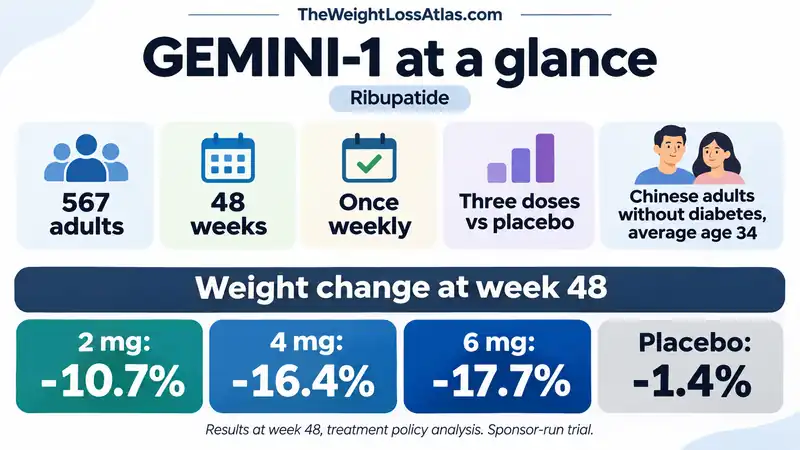
GEMINI-1
Average change in body weight. Every bar uses one scale, 0 to 25 percent.
- People studied
- 567 adults in China at 55 sites, without diabetes, with a BMI of at least 28, or at least 24 with a weight-related condition. 142 got 2 mg, 141 got 4 mg, 141 got 6 mg and 143 got placebo.
- Length
- 48 weeks, with the dose stepped up over as many as 20 weeks. Everyone also got diet counseling and advice to exercise at least 150 minutes a week.
- Compared with
- Placebo only. There was no comparison with another medicine.
- What was measured
- Percent change in body weight, and the share of people who lost at least 5%.
- Analysis approach
- Treatment-policy estimand: everyone counts in the group they were randomized to, including people who stopped treatment early. The company also reports a second view, if everyone had stayed on the drug: 11.2%, 17.4% and 19.2%.
- Other results
- The difference from placebo was 9.3, 15.0 and 16.3 percentage points. At least 5% weight loss was reached by 68.1%, 88.0% and 85.7% of the three ribupatide groups, versus 16.0% on placebo.
- Safety
- Stomach and gut effects were the most common. Nausea ranged from 16.2% to 27.0% across the three doses (placebo 4.9%), vomiting from 14.1% to 24.1% (placebo 2.1%) and diarrhea from 29.6% to 35.5% (placebo 7.0%). Permanent stops because of a side effect were 0.7% at 2 mg, 0.7% at 4 mg and 1.4% at 6 mg, versus 0% on placebo.
- Limits
- One country, an average age of 34, 48 weeks, and a sponsor-run trial. It did not test heart attacks, strokes or other long-term outcomes, and it cannot show how the drug works in other countries or after stopping.
Sources: Zhao 2026, ClinicalTrials.gov, company release
Ribupatide oral, China phase 2
Average change in body weight. Every bar uses one scale, 0 to 25 percent.
- People studied
- Adults in China with obesity, without type 2 diabetes.
- Length
- 26 weeks
- Compared with
- Placebo
- What was measured
- Percent change in body weight at week 26.
- Analysis approach
- Treatment-policy estimand. The company's efficacy estimand gave up to 12.1%.
- Limits
- Topline results from a company release, not a peer-reviewed paper. The 50 mg dose did no better than 25 mg. Phase 3 is still ahead.
Sources: company release
Who was studied
GEMINI-1 enrolled adults in China without diabetes. China uses lower BMI cutoffs than the U.S.: a BMI of at least 28, or at least 24 with a weight-related condition. The average person was 34 years old and weighed 93 kg (about 205 lb), with an average BMI of 33.3. About 55% were women, and nine in ten finished the 48 weeks.
That is a fairly young group, and everyone was told to follow a diet and exercise plan. Results could look different in older adults, in heavier populations, or in other countries. Source
Safety
In GEMINI-1, stomach and gut problems were the most common side effects, and they became more frequent as the dose went up. Any stomach or gut event was reported by 47.9% at 2 mg, 58.2% at 4 mg and 63.1% at 6 mg, versus 23.1% on placebo. Decreased appetite was reported by 19.7%, 19.9% and 24.8%, versus 3.5%.
Few people quit because of side effects: 1 person at 2 mg, 1 at 4 mg and 2 at 6 mg, and none on placebo. The company also reports that the dose was lowered because of a side effect for 1.4% at 2 mg, 11.3% at 4 mg and 19.9% at 6 mg, so higher doses needed more adjusting. No deaths were reported in the trial. Source Company slides
Four hundred twenty-four people took ribupatide for 48 weeks. That can show common effects. It cannot rule out rarer ones, and it says nothing about years of use.
What is still unknown
The trial lasted 48 weeks, so it says nothing about what happens after a year, or after stopping. It enrolled adults in China only, so it cannot say how the drug performs in other countries, in older adults, or in people with type 2 diabetes. Those groups are covered by separate trials.
It also cannot say how ribupatide compares with tirzepatide. The two act on the same receptors, but they were tested in different people, for different lengths of time, at different dose ranges, so the percentages should not be lined up against each other. We found no head-to-head trial of the two.
PeptideBlog.net has a separate analysis of how this paper reports its results, Ribupatide in JAMA: what GEMINI-1 shows, and what a 567-person China trial cannot.
Status and timeline
Dates are company-reported unless the source type says otherwise.
| Date | What happened | Source type |
|---|---|---|
| May 2024 | Hengrui licenses ribupatide outside Greater China to Kailera and keeps China. GEMINI-1 begins on May 13, 2024. | Registry, company |
| July 2025 | GEMINI-1 reaches its main goals, according to Hengrui. | Company regulatory filing |
| September 2025 | China's regulator (NMPA) accepts the marketing application for adult long-term weight management. | Company regulatory filing |
| November 2025 | Full GEMINI-1 data presented at ObesityWeek. | Company release |
| December 2025 to January 2026 | Kailera's global phase 3 program, KaiNETIC, begins. | Registry |
| November 4, 2026 | Kailera says KaiNETIC (about 5,000 participants) is fully enrolled, with data expected in mid-2028. A higher-dose phase 2b is expected to report in mid-2027, and oral phase 3 trials are expected to start in the first half of 2027. | Company filing |
| November 2026 | GEMINI-1 published in JAMA. | Peer-reviewed paper |
| November 16, 2026 | No approval found anywhere. | Atlas search |
When could it reach other countries? Neither company has announced a filing date outside China. Kailera's global phase 3 data are expected in mid-2028, so a U.S. or European filing would normally follow that. A timeline for China approval has not been announced, and any specific date you see quoted is a guess. Source Source Registry
Questions people ask
Is ribupatide approved?
No approval found as of November 16, 2026. China's regulator accepted the marketing application in September 2025 and, according to the company, it is still under review.
Are ribupatide, HRS9531 and KAI-9531 the same thing?
Yes. HRS9531 is Hengrui's code, KAI-9531 is Kailera's code outside Greater China, and ribupatide is the generic name.
How much weight did people lose?
Over 48 weeks, average weight fell 10.7%, 16.4% and 17.7% at 2, 4 and 6 mg weekly, compared with 1.4% on placebo, counting everyone as randomized.
What are the side effects?
Mostly stomach and gut problems. Nausea, vomiting and diarrhea were the most common, and they were more frequent at higher doses. Few people stopped treatment for side effects.
Is it better than tirzepatide?
Nobody knows. The two have not been compared head to head, and the trials differ in people, length and dose range.
Can I get it?
Not as a prescription medicine anywhere that we found. It is available only inside clinical trials.
When could it reach the U.S.?
No U.S. filing has been announced. Kailera's global phase 3 data are expected in mid-2028.
Is a pill version coming?
A daily tablet is in development. A phase 2 trial in China reported up to 12% weight loss at 26 weeks, and Kailera plans global phase 3 trials to start in the first half of 2027.
Sources
- Once-weekly ribupatide for weight loss in adults in China with overweight or obesity: the GEMINI-1 randomized clinical trial Zhao L, et al. JAMA, 2026. Peer-reviewed; sponsor-run. Peer-reviewed paper
- ClinicalTrials.gov NCT06396429 (HRS9531-301) U.S. National Library of Medicine. Trial registry
- Additional data from phase 3 obesity trial in China of HRS9531 Kailera Therapeutics and Hengrui press release, November 4, 2025. Company announcement; not peer reviewed. Company release
- HRS9531 phase 3 clinical trial results in Chinese adults with overweight or obesity Hengrui, ObesityWeek 2025 presentation. Company-presented; not peer reviewed. Company presentation
- Announcement of marketing application acceptance (in Chinese) Jiangsu Hengrui Pharmaceuticals, September 1, 2025. Company regulatory filing
- Hengrui media statement describing the application as accepted in September 2025 and under review Hengrui. Company statement. Company statement
- Kailera Therapeutics third quarter 2026 results (Form 8-K, exhibit 99.1) U.S. Securities and Exchange Commission filing, November 4, 2026. Company filing
- ClinicalTrials.gov KaiNETIC-1 (NCT07284875) Also KaiNETIC-2 (NCT07284901) and KaiNETIC-3 (NCT07284979). Trial registry
- Hengrui Pharma and Kailera Therapeutics present ribupatide clinical data at ADA 2026 Press release, June 5, 2026. Company announcement; not peer reviewed. Company release
- Phase 1 study of ribupatide (HRS9531) in healthy Chinese adults Diabetes, Obesity and Metabolism, 2026. Hengrui-affiliated authors. Peer-reviewed paper